Pensions have long been part of a school’s remuneration package. For teachers, this has historically been via the Teachers’ Pension Scheme (‘TPS’), with teachers contractually enrolled from the first day of employment, and for non-teaching staff, this has predominantly been via a Defined Contribution (‘DC’) arrangement.
However, after several years of rapid change the landscape looks very different, with significant variety and diversity of pension offerings.
The story so far…
Since 2019, independent schools have been considering their options around pension provision for teaching staff. This has been driven by rising TPS costs, with the last increase in April 2024 taking it up by 75% in less than 5 years, and other sector-wide cost pressures (VAT, National Insurance (NI) contributions etc).
Whilst schools have taken different approaches, from exit to sharing costs with teachers, the vast majority have now introduced a new DC arrangement, whether it be as a replacement, used for new hires or just as a voluntary alternative to TPS. To date, schools have understandably been focused on designing and implementing these arrangements and the challenging task of communicating any changes, but the next step should not be underestimated – ongoing governance of their new arrangement.
What is the current position in schools?
In England and Wales, there were 1,170 independent schools participating in TPS (broadly half of the sector) at the start of 2019. Figure 1 shows that by October 2025, 411 schools (35%) had exited TPS or indicated an intention to do so. At the same point an additional 289 (25%) independent schools had applied for Phased Withdrawal.
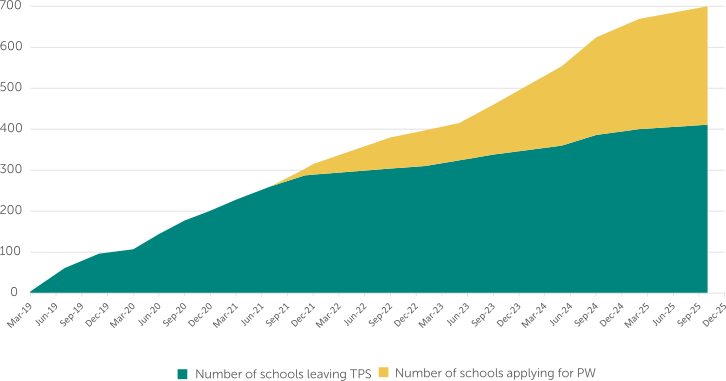
Figure 1: Declining TPS membership since March 2019 (Source: Freedom of Information requests (various) 2020-2025).
The hidden stories though, are the independent schools who remain in TPS; in our experience, a significant number of those have made changes that aren’t captured here, such as introducing a parallel option or implementing a cost-sharing arrangement.
Adding value through pension governance
Firstly, what do we mean by pension governance? Governance refers to the framework and processes an employer has in place to ensure that its pension arrangements are managed effectively, in line with legislative and regulatory requirements, and in the best interests of the members. Pensions legislation and provider propositions are not static, so it is critical schemes are monitored on an ongoing basis to ensure they are supporting you as an employer, whilst helping your people achieve retirement security.
A good example of this is the November budget announcement of a £2,000 cap on contributions made via salary sacrifice from April 2029. This doesn’t mean salary sacrifice will no longer bring benefits, indeed schools offering a cash allowance in lieu of pension contributions are already employing a mechanism other employers may now look to use to preserve NI savings, but schools should consider whether their contribution structure remains optimal.
Currently, there is no formal requirement for employers to have a governance structure in place, but we have always believed that effective governance, which we frame in our “6 pillars of DC governance” (see Figure 2) is key to this.
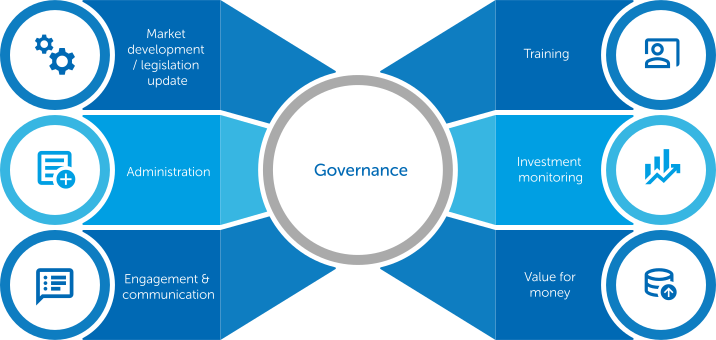
Figure 2: Six pillars of DC governance
Unlike TPS which is centrally governed, uniform in structure and relatively hands off for employers (and teachers), the choice offered by DC arrangements results in arrangements unique to each school.
It is true that pension providers provide a layer of governance – whether this is the trustees of a master trust arrangement, or independent governance committee for a contract-based arrangement (known as Group Personal Pensions) – but this is at a macro level. As the employer, you can add value by optimising the effectiveness of provider-level governance in areas such as:
Whether your scheme(s) is delivering on your objectives, whilst also providing good value for members
After salary, pension is likely your biggest ‘spend’, and so making sure this is aligned to your objectives is essential.
Some schools operate multiple DC arrangements, sometimes for legacy reasons, but we consider this to present an opportunity. Maybe to harmonise into a single arrangement with an enhanced proposition that offers better value for members (and simplifies administration for HR/payroll teams), or maybe to offer salary sacrifice as a method of paying employee contributions, providing NI savings for both the member and the school (see below).
How are your members supported to make informed decisions?
Unlike TPS where members have certainty over their retirement outcomes, with DC, flexibility around things like contribution decisions and access to pension savings will influence when and how people can retire. On the basis that you will want to support your staff into retirement it is important to help them make informed decisions, whether directly through provision of education, or by signposting to where they can find out more.
What are the likely outcomes for your members and their retirement?
Contribution decisions are the biggest influence on pension savings, so insights into how much members are saving, whether they are making active decisions about the amount they save, and how this translates into a retirement outcome are key to understanding whether your staff will be able to afford to retire.
For some employers, offering access to a pension is a tick-box exercise, but for others it is about investing in their people to support them achieving retirement security. “When thinking about retirement, the workplace pension is the most important financial element – 55% of people think it’s critical” (Source: The At Retirement Reckoning, Barnett Waddingham, September 2024). With this emphasis on the workplace pension, it is more important than ever that employers get it right.
And governance isn’t limited to DC arrangements. For those independent schools who continue to offer TPS in any form, the ongoing review of this decision – in the context of the school’s wider objectives – will also be important, as well has how you continue to engage with teachers in relation to their TPS membership.
The risks of getting it wrong
Put simply, at a member level, the risk of poor governance is a poor member retirement outcome.
Beyond this for the employer, any failures in relation to the running of a pension arrangement can require significant work to address, and the longer issues go undetected the more remedial work is required.
Some of the key areas of risk we have identified (or seen in our experience) include:
Pension contributions
Incorrect deductions – including the percentage, contribution method (i.e. unlike TPS some (but not all!) DC arrangements have deductions paid to the scheme after tax), pensionable salary definition or incorrection application of salary sacrifice.
Opting out of TPS / into DC alternative
Incorrect documentation of the process, including individuals not completing a TPS opt out form before enrolling into the DC alternative.
Auto-enrolment/re-enrolment
Absence of auto-enrolment certification (in our experience, very few schools have these in place prior to our involvement).
Re-enrolment and the interaction with Phased Withdrawal (anyone who opts out of TPS before Phased Withdrawal should be re-enrolled into TPS).
Easy wins?
Design
DC arrangements can be as simple or advanced as needed, but reflecting on the school’s objectives and current pension design may generate some easy wins and more fundamentally, opportunities to design the best possible arrangement for all staff.
If you haven’t already, looking at the teaching and non-teaching staff populations together may create opportunities to improve the offering for non-teaching staff; perhaps lower management charges and improved options.
With schools squeezed by cost pressures, salary sacrifice (sometimes referred to as ‘salary exchange’) offers a way to make a relatively easy cost-saving. Commonly used in DC arrangements, this can be a more tax-efficient way of making employee contributions. Under this method, employees agree to a contractual reduction in salary equivalent to their pension contributions and, in exchange, this is made as an additional school contribution. As salary is reduced, both the member and the school pay less NI.
On first look, the November Budget announcement of a £2,000 cap on contributions made via salary sacrifice from April 2029 may put schools off, but in our view, this still leaves over two years for members and employers to take advantage of the NI savings available, but more importantly, it gives an opportunity to reconsider overall contribution design. Schools who already offer flexibility around teacher contribution levels, may be able to extend this to non-teaching staff, for example.
Note: comments about rethinking scheme design do not relate to reviewing existing contribution spend (unless that is something you wish to consider), but instead, how that spend is shaped.
Benchmark
Governance can be tailored to your objectives– from light touch support, through to a comprehensive governance strategy.
If you are new to governance, a good starting point would be to think about what you want to achieve from governance, and who should be involved. Your consultants can help by providing guidance on who should sit on the Pensions Governance Committee and their respective roles and responsibilities.
The next step would be to take stock of your existing arrangements – building a clear picture of what is in place, and reflect on why, based on the 6 pillars of DC governance outlined above. Incorporating data analytics will help provide a meaningful analysis and provide insight into potential member outcomes, savings behaviours and engagement levels.
Not only does governance hold up a mirror to your scheme(s), more importantly it informs how you can take positive action to deliver better outcomes.
The bottom line…
Every school’s objectives are different, so governance should be tailored. But, done well, it protects your school, supports your staff, and ensures pensions deliver real value.
This article was first published in the Spring edition of The Bursar’s Review.