Credit spreads (the extra yield investors earn for holding corporate bonds over “risk free” government securities) have been flirting with multi decade lows over the past year. You can see this in the chart below. While prolonged low spreads often signal a stable economic backdrop, they can just as easily serve as an early warning.
When spreads are low, the risk profile becomes more asymmetric: there is limited scope for further lowering, but considerable room for spreads to rise, which would negatively impact bond valuations. History also demonstrates that credit cycles can turn abruptly, leaving bond investors exposed if they are not appropriately prepared.
In this blog we look at the reasons why spreads may be so compressed, what might trigger a reversal, and how investors can position their portfolios to protect against the associated risks.
Credit spreads relative to 20-year percentiles
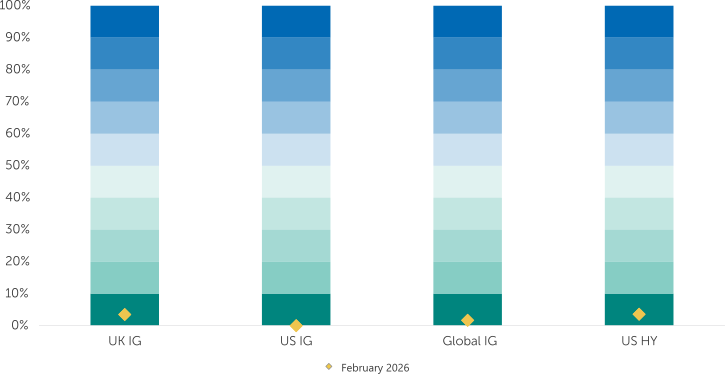
Source: iBoxx, FTSE. Data as at 3 February 2026. Spreads have drifted modestly higher over March and April but remain tight relative to history.
Why are spreads currently low?
The resilience of credit markets may seem at odds with an environment of heightened geopolitical risk, high borrowing costs and wider market uncertainty. But there are a number of fundamental and technical factors that have combined to keep spreads anchored near multi-decade lows. Understanding these factors can help to assess what might ultimately lead the trend to unravel.
- Corporate balance sheets remain healthy, with many companies continuing to report resilient earnings, strong liquidity and manageable leverage after years of cheap financing.
- A supportive macroeconomic backdrop, combined with strong company fundamentals, has led investors to assign a low probability to companies defaulting on their debt.
- Government bonds are cheap. Credit spreads reflect the market’s view of the relative risk of lending to companies versus lending to governments. While leverage has been falling for companies since the financial crisis, the government debt burden has been increasing. Higher government bond yields, driven by fiscal concerns as well as supply and demand dynamics, have therefore narrowed the gap to corporates. In fact, if we compare the yield on corporate bonds to swaps, spreads appear closer to long-term averages, but the trend downwards is still noticeable, as shown in the chart below.
- High all-in yields, driven by high government bond yields, have drawn significant inflows into credit markets, with investors seeking higher levels of income following a decade of low yields.
- New debt has been limited, as many companies had already refinanced when borrowing costs were low. This scarcity of supply combined with strong demand has helped to keep spreads compressed.
Spread relative to swaps
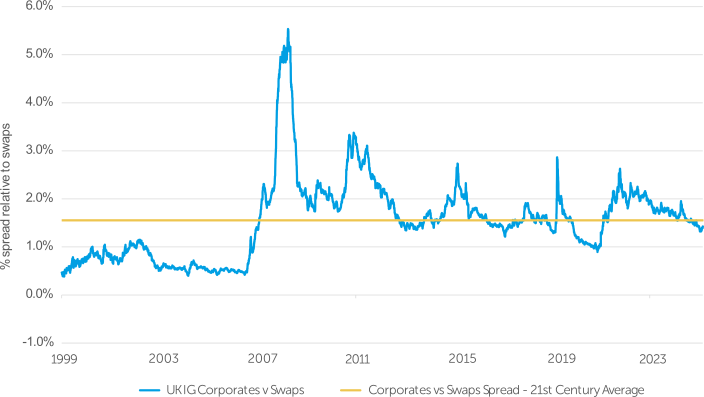
Source: iBoxx, Merrill Lynch
What might cause this to change?
Credit spreads historically revert to the mean, which means the question tends to be less about if they widen, but rather when – and how quickly. Many of the factors that we’ve already covered highlight the reliance of current valuations on favourable conditions continuing. To understand the risks, investors should consider what could challenge this stability and lead to spreads widening.
Some factors to consider:
1. Deterioration in corporate fundamentals
Slowing global growth could begin to weigh on earnings, while supply-chain disruption from tariffs and geopolitical conflict may erode margins in the form of higher input costs. At the same time, many companies that had previously borrowed cheaply may soon be refinancing at materially higher rates, leading to a potential repricing of default and downgrade risk.
2. Technical stress and market dynamics
Spread widening may also result from structural shifts in supply and demand, even if balance sheets remain resilient. For instance, central banks continuing to cut rates may create a fall in the demand we have seen from yield-chasing investors. At the same time, institutional flows are rotating, with more and more DB schemes transferring assets to insurers, who themselves are increasingly favouring gilts over credit. Waves of refinancing and the prospect of large issuance from major tech firms could also be set to increase the competition for capital, putting upward pressure on spreads.
3. Geopolitical tensions
We have recently seen spreads edge wider as the escalating Middle East conflict weakens broader risk sentiment. The surge in energy prices and trade disruption around the Strait of Hormuz, if prolonged, may see renewed concerns around inflationary pressures and lead to a tighter policy stance from central banks.
The reality is that sudden spread widening episodes are rarely caused solely by the risks that we see coming. Instead, it has often been the “unknown unknowns” - a sudden policy shift, liquidity crisis or even a pandemic -that have hit credit markets hardest. At current valuations, the downside risks outweigh the potential upside.
Managing the risks
An immediate sharp widening of spreads is not necessarily inevitable. Spreads can stay low for extended periods, as history shows. The key point is that unprepared investors may be exposed to risks for which they are currently receiving relatively little compensation. With that in mind, here are some ways credit investors can manage those risks.
Don’t be a forced seller
Historically, when credit spreads have widened sharply they have not typically stayed wide for long, “correcting” themselves as market sentiment stabilises.
Mark-to-market losses from spread movements are only made permanent if an investor sells before the bond matures. Otherwise, losses are ultimately governed by the level of defaults.
Even in the most stressed periods, defaults in investment-grade credit have previously remained low and allowed portfolios to ride out volatility. In fact, even investors who remained invested in US high yield recovered losses one year after the 2008 Lehman Brothers bankruptcy, whereas those who sold crystalised significant losses.
Lessons from history: Global Financial Crisis
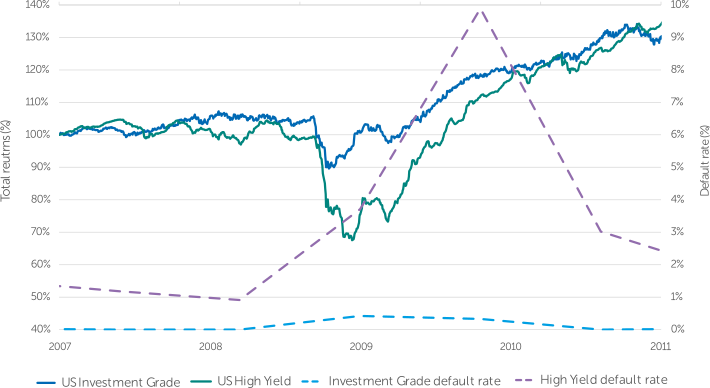
Source: iBoxx, FTSE
The key message:
- Understand what you are holding and avoid selling if you remain confident in the quality.
- Match your bond maturities to your investment horizon, to avoid having to sell at inopportune times.
- Favour active management. Passive funds may be forced sellers of downgraded bonds if they fall out of the relevant index, often at the point where valuations are most stressed. A well-chosen active manager can instead look to capitalise on selloffs.
Keep duration low
Bonds with a lower (spread) duration are less sensitive to spread movements. Investors can reduce volatility by tilting towards shorter-dated bonds, including asset-backed securities, which currently offer an attractive premium over equivalently rated corporates.
It’s also worth bearing in mind that the additional yield on longer term bonds versus shorter term bonds is currently modest, meaning investors can earn similar levels of income with significantly lower volatility by holding shorter maturities.
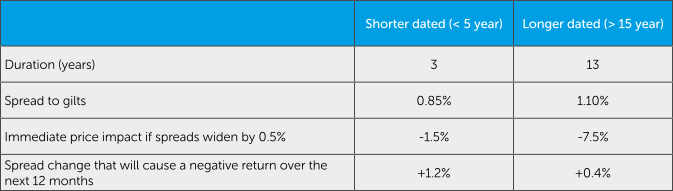
iBoxx 1-5 year UK Corporate Index and iBoxx 15+ year UK Corporate Index
Diversification
As with any form of investing, diversification remains one of the most effective ways of reducing risk. Credit shocks may emerge in specific sectors, geographies or ratings before spreading more widely.
Lessons from history: 2014-2016 oil price collapse
The 2014–16 oil price collapse is a clear example of stress largely being confined to one sector. Energy related high yield spreads blew out significantly, while other sectors remained broadly stable. Portfolios that were more heavily exposed to energy or US high yield (large concentration to shale) were hit more harshly than a well-diversified portfolio.
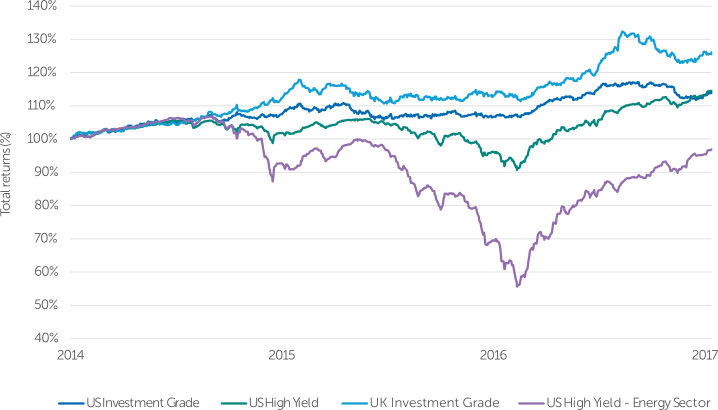
Source: iBoxx, FTSE
The same principle applies today. For example, the software sector, which occupies a large share (c.13%) of the leveraged loan market is currently facing pressure, with investors seeing AI as a threat to the future demand for software products.
Be ready to capture opportunities
Widening spreads can pose risks, but also present opportunities, at times presenting attractive entry points for investors. Having some liquidity, either directly or by delegating to a multi-asset manager, can allow investors to take advantage of spread dislocations.
What message should you take away?
Low credit spreads are not themselves a catalyst for a downturn, but they do increase exposure to adverse developments while leaving little scope for capital gains. So the task for credit investors is to ensure their portfolio is robust across a range of outcomes. By controlling duration, aligning maturities with your holding period, diversifying your exposure and maintaining flexibility to capitalise on more favourable pricing, investors can build a more resilient strategy.
If you would like to discuss how best to apply these principles within your credit allocation, please get in touch with your Barnett Waddingham consultant.
Michael Hall, Investment Client Manager, and Ciaran Gallagher, Investment Client Specialist, contributed to this blog.

Our investment consulting services
Discover more about the range of services, commentary and insights from our expert investment consulting team.
Find out more
Stay up to date
Get the latest independent commentary and exclusive insights from a range of experts at the forefront of risk, pensions, investment and insurance – tailored to your preference.
Subscribe today