Member mortality is one of the key considerations of LGPS funding. Pension benefits are paid for life, so how long members are expected to live has a direct and material impact on the value of benefits promised by LGPS funds. Longevity risk – the risk that members live longer than assumed – is therefore one of the most significant risks LGPS funds must manage.
Getting these assumptions right matters not only for long‑term funding strategy, but also for the contributions paid by employers and for the liabilities disclosed in employer accounting. Small changes in assumed life expectancy can translate into meaningful changes in liabilities over time.
As part of the 2025 actuarial valuation, the BW specialist longevity team carried out in‑depth mortality and longevity analysis for our LGPS clients. This bespoke analysis allows actuaries to take each Fund’s unique membership profile into account when setting assumptions, rather than relying on generic “one‑size‑fits‑all” approaches.
This blog initially looks back at the mortality experience observed at the 2025 actuarial valuation and summarises the resulting outcomes for mortality assumptions. We then outline what Funds and employers can expect for the March 2026 accounting exercise, where these assumptions will be updated.
Experience observed at the 2025 valuation
Mortality experience over the inter‑valuation period was mixed and varied significantly by Fund.
- Experience differed between Funds: Some Funds experienced lighter mortality (fewer deaths than expected), while others saw heavier mortality (more deaths than expected) relative to their assumptions.
- For the most part, experience was minor: The deviations from expected deaths were generally modest and, in most cases, well within the range of normal volatility.
Taken together, this indicates that the mortality assumptions set at the previous valuation in 2022 remained broadly reasonable. The limited scale of experience gains and losses also reinforces the importance of analysing experience over a sufficiently long period and avoiding over‑reacting to short‑term fluctuations.
Future mortality assumptions
Similarly, the updates made to the mortality assumptions and estimated life expectancies varied.
While on average life expectancies have remained broadly the same since 2022, most Funds have seen an increase or decrease in assumed life expectancies reflecting their individual mortality assumptions.
Below we have illustrated the change in life expectancies for 85 LGPS Funds between 2022 and 2025. The results once again highlight that there is no single “LGPS mortality story”.
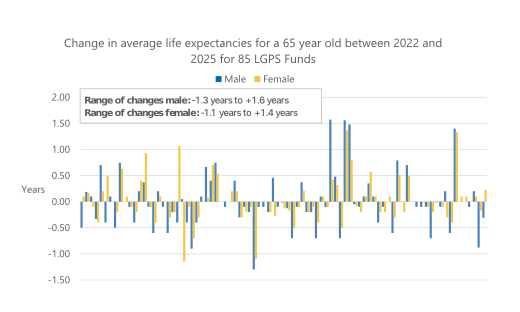
Ultimately, changes in future assumptions come down to each Fund’s unique membership profile and past mortality experience. This underlines the importance of bespoke longevity analysis. Tailoring assumptions to individual Fund experience helps ensure that liabilities are neither understated nor overly prudent, supporting sound funding decisions for both Funds and employers.
COVID-19 and mortality modelling
Future mortality projections are based on the CMI mortality projection model, which is developed and maintained by the Continuous Mortality Investigation (CMI), a body within the Institute and Faculty of Actuaries (IFoA).
The model is updated annually, with the move from CMI_2023 to CMI_2024 being particularly important. This update included a significant overhaul of the model to better reflect the unusually high excess mortality observed during the COVID‑19 pandemic. No significant changes were required to the structure of the model for the latest version, CMI_2025, which compared to CMI_2024 shows a small increase in life expectancies on average.
At the 2025 valuation, projected life expectancies are the highest seen since the pandemic, reflecting a degree of normalisation following the severe disruption of 2020–2022. That said, life expectancy projections remain lower than pre‑pandemic expectations. The long‑term effects of COVID‑19, coupled with broader health and societal trends, continue to influence mortality assumptions.
Implications for employer accounting
Mortality changes will be reflected in employer accounting disclosures in two key ways:
Experience gains and losses
First, mortality feeds into the experience item in employers’ liabilities shown in the accounting reports, capturing differences between expected and actual outcomes over the last three years.
- More deaths than expected typically reduce liabilities, as pensions are not paid as long as assumed.
- Fewer deaths than expected generally increase liabilities, as pensions are expected to be paid for longer.
Mortality experience will differ between employers as it is dependent on each employer’s unique membership experience observed over the intervaluation period.
Mortality experience is only one part of the experience item shown in the accounting report. The item also represents factors such as differences in expected and actual retirement ages, withdrawal rates, and commutation behaviour, among others.
Changes in demographic assumptions
Second, the impact of changing mortality assumptions forms the central part of the change in demographic assumptions item affecting each employers’ liabilities.
At this year’s March 2026 accounting exercise, employer mortality assumptions will be updated to align with the now‑complete 2025 actuarial valuation. In addition, most employers are expected to update the mortality projection basis further, moving to the recently released CMI_2025 model.
As a general rule of thumb, higher life expectancy increases liabilities, while lower life expectancy reduces them, as benefits are expected to be paid over a longer or shorter period. However, the magnitude of the accounting impact will vary between employers and depends on several factors:
- The valuation assumptions adopted by the Fund in which the employer participates,
- the employer’s bespoke membership profile, as changes in life expectancy differ by gender and age group, and
- the assumptions used at the current and previous accounting exercises, noting that employers have some discretion over how frequently they update the CMI model.
The impact on liabilities of these changing life expectancies linked to updating the mortality assumptions for the 2025 valuation depends on each Fund’s membership profile. However, overall, the changes illustrated above will lead to a change in liabilities within the range of -2.5% to +2.5%.
In addition to this, updating the CMI model from CMI_2024 (used at the 2025 valuation) to CMI_2025 will on average increase liabilities by 0.5%.
To support employers and auditors, we have prepared additional information within our March briefing note and accounting FAQs. We are also always happy to discuss mortality assumptions directly with auditors and respond to any follow‑up questions.
If you would like to explore how mortality experience or future assumptions affect your Fund or accounting disclosures in more detail, please get in touch with your usual BW contact.

LGPS valuations insight
See more of our independent commentary and exclusive insights covering all aspects of LGPS valuations to help your scheme.
Read more
Stay up to date
Get the latest independent commentary and exclusive insights from a range of experts at the forefront of pensions, investment, risk and insurance – tailored to your preference.
Subscribe today