 Skip to main content
As more defined benefit (DB) schemes choose to run on rather than move straight to buyout, attention is turning to how investment strategies can be refined to improve outcomes for members and sponsors.
Our recent blog, Making your assets work harder in run-on, explored how investment strategy can support this direction of travel.
This article looks at the other key lever: liability hedging. By setting hedging in line with your run-on objective, time horizon and surplus policy, trustees and sponsors can reduce funding level volatility, preserve transaction affordability and create more scope for surplus, without taking unrewarded risk.
Why hedge?
In the world of DB pensions, unrewarded risks such as interest rate and inflation risk can significantly affect funding levels as markets move. Hedging these risks helps to align assets and liabilities so they move together, reducing volatility and giving trustees and companies more certainty for future planning.
Why run on?
As we have previously explored in our blog The value of running on your DB pension scheme, DB schemes are paying away millions to insurance companies in surplus assets through buyout transactions.
Recent regulatory change has provided more flexibility around releasing surpluses. Trustees and sponsors with strong funding positions can now consider using this surplus by running on, even if the ultimate aim remains to buy out with an insurer eventually.
But in a run-on strategy, your short-term objective (for example, return generation) and long-term objective (for example, buyout) can be somewhat conflicting. This flows through into the hedging strategy and the liability basis chosen to hedge. Done right, your hedging strategy becomes a lever to support surplus in a risk-controlled way.
Run-on hedging strategy: one size doesn’t fit all
Key questions include:
- Time horizon – How long is the scheme expected to run on for? At what point is a buyout transaction likely to be the most efficient way forward (for example, when the scheme is mature and the asset size is small)?
- Surplus distribution strategy – Is surplus intended to augment member benefits (as an uplift to benefits or cash payment), be returned to the sponsor, or a combination of both?
- Covenant strength – How much can you rely on the willingness and ability of the sponsor to make up any deficit if the funding position deteriorates?
The answers will shape both your hedging basis and how tightly you hedge against it.
Option 1: Hedge solvency proxy
✅ Best suited to schemes targeting buyout in the short to medium term.
✅ Delivers maximum security to members, as there is greater certainty that liabilities will be covered in full on a solvency basis.
✅ Protects against the risk of covenant deterioration: if done well, minimal additional capital is needed at the point of transacting with an insurer (with respect to interest rate and inflation risk alone).
Key considerations
- Potential over-hedging relative to best estimate liabilities, which may act as a drag on returns if you expect to pay a significant proportion of benefits out ahead of a transaction.
- Solvency pricing is volatile and cannot be hedged precisely, as it is affected by both long-term market dynamics and short-term factors (linked to supply/demand in the buyout market, as well as changes in regulation). This may affect the amount of surplus that can be extracted.
If your scheme is aiming to run on for a few years before buying out, one option is to target a hedge close to the proxy solvency basis – but not all the way to 100%. Aiming below 100% gives you protection while allowing for the uncertainty in insurer pricing that grows the longer you run on.
If you are planning to run on for the long term, you are likely to lean towards Option 2.
Option 2: Hedge best estimate
✅ Better suited to long-term run-on – you hedge what you expect to pay.
✅ Supports surplus stability relative to the best estimate basis, assuming benefits are paid broadly in line with expectations over time.
✅ Creates potential for higher surplus – less hedging typically means more capital available for growth assets, or reduced leverage.
Key considerations
- Offers less protection if buyout happens sooner than expected – if rates fall, this strategy could hurt the affordability of a transaction.
- With no prudence in the liability basis, worse-than-expected experience may reduce surplus or require a top-up from the employer before buy-in or buyout.
Illustrative modelling: hedging choice and surplus outcomes
To illustrate the trade-offs, we modelled how two different hedging approaches might affect surplus over the next 10 years for a hypothetical £1bn scheme. The results highlight the potential for higher surplus when hedging on a best estimate basis – but also the impact on solvency-basis volatility.
We also show a three-year Value-at-Risk (VaR) snapshot, reflecting a typical timescale for strategy review or surplus extraction.
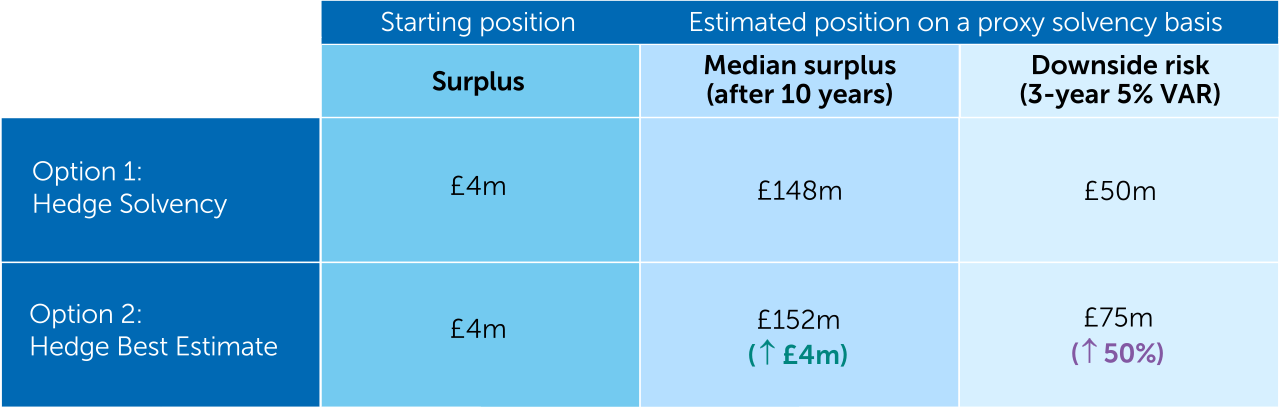
The example assumes both scenarios keep the same strategic asset mix, with less leverage when hedging best estimate. In practice, hedging on a best estimate basis could free up additional capital for return-seeking assets, potentially boosting surplus further – but with a corresponding increase in risk.
Option 3: Somewhere in between
Options 1 and 2 sit at two ends of a spectrum. For many schemes, the most effective approach lies somewhere in the middle.
Option 3a: Hedge gilts flat
✅ A low-risk basis which avoids over-tracking annuity pricing when a transaction may be some distance away.
✅ Avoids some of the prudence in solvency, which may result in less hedging and more capital for growth assets.
✅ Less influenced by short-term noise (for example, insurer supply/demand or regulatory change), which may improve the stability of the surplus that can be extracted. It is also straightforward to interpret.
Key considerations
The gilts-flat basis is not directly linked to funding, nor is it the cost to buy in the liabilities – it is a proxy. This means you may still need top-up funds to enable a buy-in or buyout to happen.
Option 3b: Hedge a low-dependency basis
✅ Aligned with schemes that do not plan to buy out for some time. Reflects the expectation that you will invest in an asset strategy which returns above gilts to generate a surplus, but nothing more than this.
✅ Potential for funding level improvement versus solvency if rates rise during the run-on period, as you are likely to have a small under-hedge relative to solvency (for example, 5–10%).
Key considerations
The low dependency basis is expected to introduce an additional layer of volatility versus the cost of buyout compared to using a solvency proxy, which means a larger top-up may be required prior to buy-in or buyout if that remains the ultimate goal.
For schemes targeting buyout as the ultimate end goal, a hybrid strategy is also possible. A bespoke liability benchmark may be constructed to reflect the scheme-specific run-on journey plan – for example, best estimate over the run-on time horizon and estimated solvency cost thereafter. Given the bespoke nature of this approach, it is most likely to be appropriate for very large or complex schemes.
Should the surplus be hedged?
The short answer is no. The longer answer depends on how the surplus will be used.
If surplus is used to uplift member benefits
Where benefit uplifts occur at regular intervals, the surplus will gradually be absorbed into the liabilities. As this happens, hedging can be increased incrementally at each review. This avoids the risk of over-hedging, particularly if markets move unfavourably and surplus is depleted before the uplift is implemented.
If the goal is to maximise surplus
Hedging the funding level will lock in coverage of the assets relative to the liabilities. But when surplus growth is the priority, over-hedging the liabilities can erode positive performance.
For example, if yields rise your liabilities will fall but the assets will fall further on a best estimate and solvency basis resulting in a reduction in surplus. Overall, this increases the volatility of the surplus in pound terms. We would therefore not recommend hedging the surplus if it is intended to be extracted as cash.
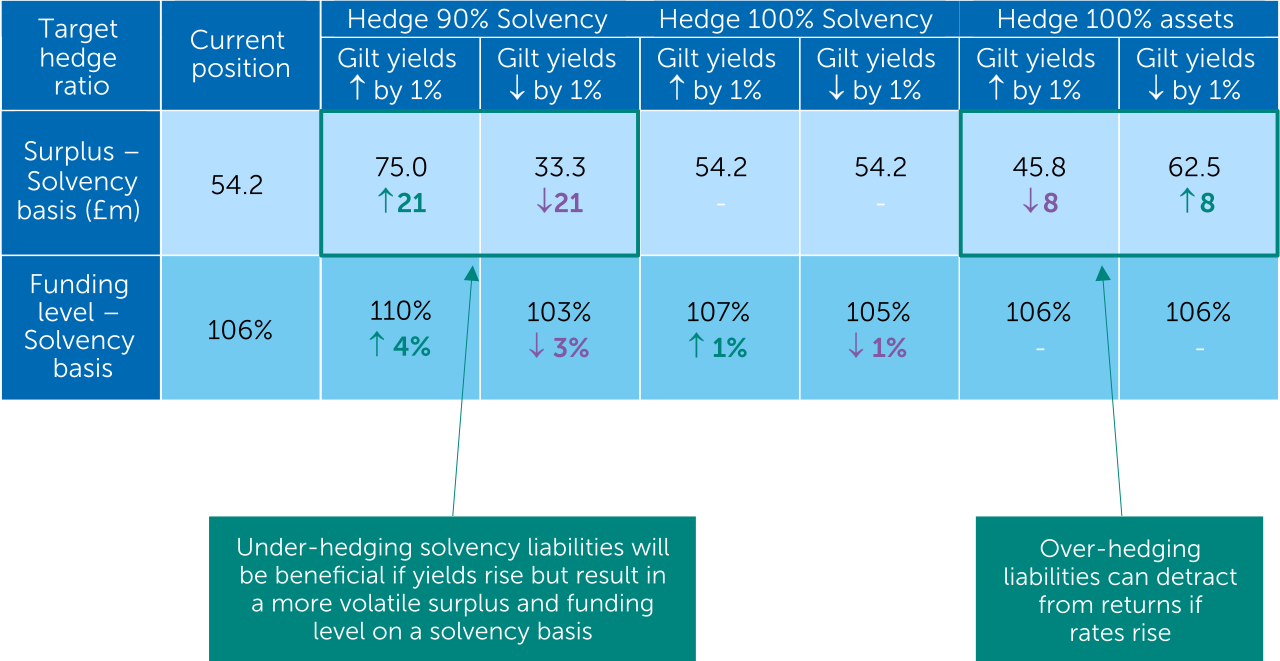
If surplus is to be extracted, hedging the surplus – that is, hedging 100% of assets – will preserve the funding level, offering greater stability on this measure. However, this comes at a cost: surplus will be more volatile, and there will be less potential for future surplus growth. Additionally, if surplus extraction is planned at regular intervals, hedging would need to be reduced at each point of extraction. This introduces complexity in governance and asset transfers, as timing would need to be carefully aligned.
For these reasons, we would tend to recommend against hedging the surplus – that is, above the value of the liabilities – whatever the chosen hedging basis.
Takeaway
If you are in run on and want to maximise value, your hedging basis and hedge ratio are pivotal. Set them to match your objective, timescale and surplus policy and be ready to adjust as you move toward your endgame. Speak to your BW investment consultant for a health-check of your run-on hedging approach.
Emma Gourdie, Investment Consultant, co-authored this blog.

Contact us for all enquiries
For more information about the independent, expert services we provide in this area, speak to our team today.
Get in touch

Investment Consulting
Investment consultant advice tailored to each pension scheme, trustee board and organisation with strategy and risk at the core.
Read more