 Skip to main content
This report presents the results of our first Capital Benchmarking Survey, powered by validateR, BW’s award-winning, cloud-based validation automation tool.
We present a unique view of market practice across a selected group of insurance firms and Lloyd’s syndicates, drawing directly on internal capital model simulations. Using simulation data, we are able to conduct analysis and offer insights that would not be possible using data from public disclosures or standard regulatory reporting.
The analysis is designed to support capital modelling teams, risk functions and senior stakeholders by highlighting areas of convergence and divergence in market practice, and it provides context for internal challenge, validation and ongoing model development.
Highlights from the survey
Figure 1 shows the gross mean reserves against the standard deviation of Reserve Risk for each capital class in the survey. The two dashed blue lines on the plot define the CoV thresholds of 10% and 50%. The results suggest that most of the capital class CoVs in our survey fall within this range.
Figure 1: Reserve Risk: Mean gross reserves vs standard deviation on an ultimate basis.
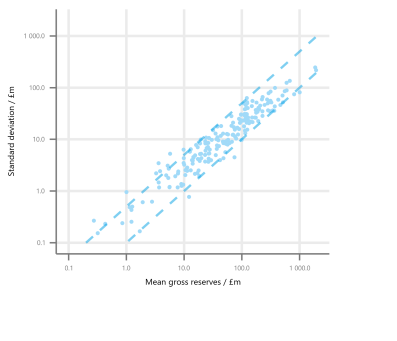
Figure 2 shows the joint exceedance probability (JEP) curves between Reserve Risk and Premium Risk. The thick blue dashed lines represent JEP under independence (lower) and perfect dependence (upper). The fan plots show the 10th to 90th percentile JEPs at 10% increments. The central dashed line shows the mean of our benchmark data. The distribution of JEPs for Reserve vs Premium Risk shows strong dependency throughout the distribution. There is reasonable consensus in the strength of the relationship across our survey participants, shown by the narrow shaded region.
Figure 2: Joint exceedance probabilities (JEPs) between Reserve Risk and Premium Risk on an ultimate basis.
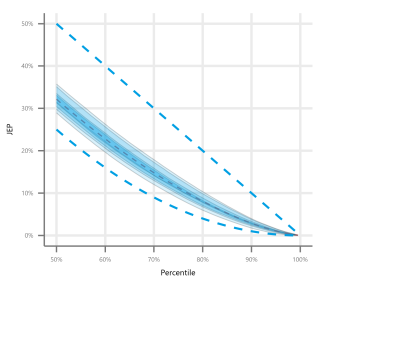
Figure 3 shows the ratio of capital at selected return periods to the 1-in-200 level. Although calibration at the 1-in-200 year return period remains the primary objective of most capital models, to deliver broader value to the business models must produce credible and coherent results across a range of adverse return periods. This analysis provides insight into the shape and behaviour of the tail outside of the capital-setting scenario.
Figure 3: Ratio of total capital at selected percentiles relative to the 99.5th percentile on an ultimate basis
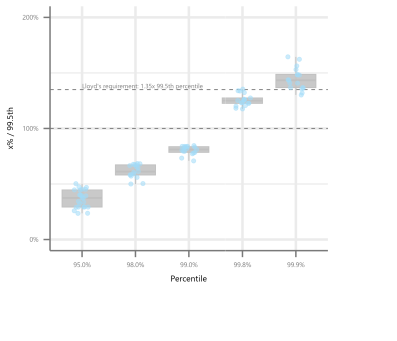
Lloyd’s monitors the ratio of capital between the 1-in-500 and 1-in-200 year return periods (i.e. the 99.8th relative to the 99.5th percentile), with an expectation that this ratio does not exceed 1.35.
The ultimate view shows some clustering just below this threshold, which may reflect responsiveness to Lloyd’s oversight criteria rather than underlying risk characteristics. Given this relative consistency in tail scaling, capital at lower percentiles (e.g. 95th) can be inferred with reasonable approximation from the 99.5th percentile, providing a useful cross-check on distributional shape.
Access the non-participant version of the report
To receive an abridged version of our report, please complete the brief form below. Access to the full report is reserved for survey respondents.
If you would like to explore participating in the next edition of our survey, and thereby gain access to the full report as well as future releases, we would be delighted to discuss this with you.