From early 2027, the European Union’s (EU’s) Solvency II reforms will significantly improve the capital treatment of asset‑backed securities (ABS). Solvency UK reforms are expected to follow. For European insurers, this marks a major shift: an asset class that historically carried punitive capital charges will soon become far more attractive, opening the door to enhanced portfolio diversification.
While the regulatory details have been widely discussed elsewhere, this blog focuses on what really matters for investors in ABS, the opportunity these reforms create, and how insurers and other institutional investors can position themselves ahead of time.
What is the current situation?
From a risk and return perspective, ABS is an attractive asset, which is already well allocated to by institutional investors such as pension schemes, charities and family offices. But it does not currently feature heavily in European insurers’ investment portfolios. Why not? Following the global financial crisis in 2008, the Solvency II and Solvency UK regimes meant much of the ABS universe was (and still is) heavily penalised from a capital charge perspective. This resulted in a significant reduction in ABS investment.
One subset of the ABS universe which insurers do invest in is “Simple, Transparent and Standardised” (STS) ABS. These assets have lower capital charges compared to “non-STS” ABS which makes them attractive within an insurer’s portfolio.
Put simply, STS ABS are asset‑backed securities that follow EU rules to be simple, clear, and predictable. While non‑STS ABS don’t follow those rules, they are not necessarily “bad”, they are just less tightly regulated, more complex and/or less transparent.
However, under current regulation, both STS and non-STS ABS have a materially higher capital charge compared to a corporate bond of equivalent credit rating, so often ABS does not make sense from a capital perspective to sit within an insurer’s asset portfolio in any capacity.
What is changing?
In 2025, draft reforms to Solvency II set out plans to change the capital charge treatment for ABS investments, which are expected to come into effect in early 2027.
Capital charges (standard formula spread) on ABS are expected to be lowered materially due to these updates for both STS and non-STS ABS as shown in the chart below.
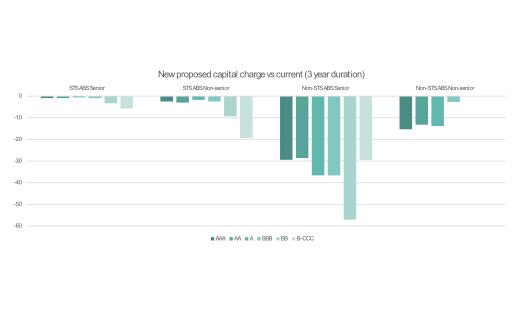
Source: European Commission (19 July 2025) Draft Delegated Regulation amending Delegated Regulation (EU) 2015/35 on Solvency II (Ref. Ares(2025)5843909 - 17/07/2025), European Commission (16 November 2024) Delegated Regulation (EU) 2015/35 of 10 October 2014 supplementing Directive 2009/138/EC of the European Parliament and of the Council on the taking-up and pursuit of the business of Insurance and Reinsurance (Solvency II) (Document 02015R0035-20241114).
The capital charge on senior STS ABS will fall below, or be comparable to, an equivalent corporate bond. Meanwhile, the capital charges on non-senior ABS will be risk-based. Hence, ABS further down the credit rating spectrum will still attract a higher capital charge. The chart below shows the difference between ABS and equivalent corporate bond capital charges following the proposed changes.
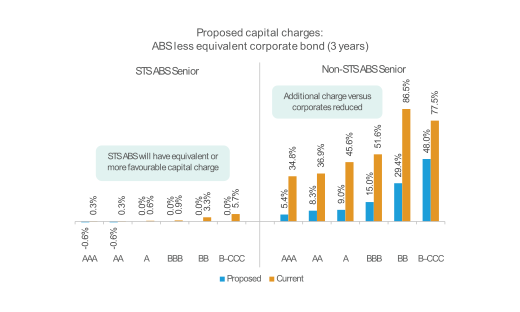
Source: European Commission (19 July 2025) Draft Delegated Regulation amending Delegated Regulation (EU) 2015/35 on Solvency II (Ref. Ares(2025)5843909 - 17/07/2025), European Commission (16 November 2024) Delegated Regulation (EU) 2015/35 of 10 October 2014 supplementing Directive 2009/138/EC of the European Parliament and of the Council on the taking-up and pursuit of the business of Insurance and Reinsurance (Solvency II) (Document 02015R0035-20241114).
Illustrative example strategy
Below, we present an illustrative example demonstrating how the proposed reduction in capital charges on ABS could enable insurers to construct more efficient portfolios by reallocating a portion of corporate bond holdings into ABS.
For simplicity, the analysis is restricted to senior STS ABS. We assume that both the ABS and corporate bond allocations have an average credit rating of A and an average duration of ~3 years. Keeping these parameters consistent allows us to isolate the impact of the proposed capital charge changes and highlight their potential effect on portfolio efficiency.
Naturally, the extent of any improvement in risk adjusted return on capital will depend on an individual insurer’s specific risk profile, including factors such as duration, credit quality, and portfolio composition, which are likely to be more complex than those captured in this illustrative example. With more detailed analysis, there may be further opportunities to enhance risk adjusted returns by incorporating ABS under the proposed revised capital framework.
|
IG Corporate bond (A rated, ~3y duration) |
STS Senior ABS equivalent (current capital charge) |
STS Senior ABS equivalent (proposed capital charge) |
|
| Spread | 0.7% | 0.9% | 0.9% |
| Spread volatility | ~0.4% - 0.6% | ~0.20% - 0.35% | ~0.20% - 0.35% |
| Solvency capital requirement (SCR) | 3.3% | 3.6% | 2.7% |
| Return on capital (RoC) | 21.2% | 25.0% | 33.3% |
| Change in RoC | - | 3.8% | 12.1% |
Source: Barnett Waddingham
These changes clearly open capital efficient opportunities in the ABS market for European insurers.
Potential investment opportunities for insurers
The changes to solvency capital charges for ABS, expected to take effect in early 2027, create a significant opportunity for insurers to increase their exposure to the asset class in a capital efficient way. This is a genuinely investable space, with a small number of asset managers already offering STS friendly strategies and pooled vehicles, but the expectation is that the more favourable capital treatment will encourage more asset managers to enter the market.
Currently, only a small number of asset managers are building ABS portfolios for insurers, and an even smaller subset offer pooled fund structures. Most of these portfolios focus on STS ABS; however, we do not believe insurers need to restrict themselves solely to the STS universe. With the forthcoming capital charge reforms, non‑STS ABS such as CLOs are becoming significantly more attractive. These assets can be blended with STS ABS to create a capital efficient portfolio with compelling risk and return characteristics.
As a result, insurers should see a growing range of solutions designed to provide capital‑optimised access to ABS. This expansion of the manager universe makes careful manager selection critical, particularly in identifying those with deep, demonstrable expertise in the asset class.
While ABS benefits from structural protections and diversified collateral pools that help reduce idiosyncratic credit risk, these features place even greater emphasis on choosing the right manager. Ultimately, it is a complex and at times opaque asset class so you want your manager to have the ability and experience to navigate the complexity.
Conclusion
With the forthcoming changes to Solvency II, ABS is poised to become a far more significant component of insurer portfolios. The asset class offers a rare combination of capital efficiency, diversification, yield enhancement, and structural resilience.
If you are considering adding ABS to your portfolio, please contact your Barnett Waddingham investment consultant to discuss your options.
Emma Gourdie, Investment Consultant, co-authored this blog.

Our investment consulting services
Discover more about the range of services, commentary and insights from our expert investment consulting team.
Find out more
Stay up to date
Get the latest independent commentary and exclusive insights from a range of experts at the forefront of risk, pensions, investment and insurance – tailored to your preference.
Subscribe today