 Skip to main content
A key takeaway from our blog, Are you confident your investment manager will deliver?, was that a higher fee doesn’t necessarily lead to better performance. In this blog, we expand on the research behind this conclusion and outline why there are sometimes valid reasons for fees to differ.
Manager selection is key. Not all providers are equal, and the right manager for you may not necessarily be the cheapest. In a universe of multi-asset managers, some are more ‘active’ than others, and fees and track record alone do not paint the full picture. You should understand how your manager compares with their peers on a range of aspects.
If you would like to know how your manager compares with the market – whether this is on fees, service or broader investment offering – get in touch.
What the data tells us
Our analysis looked at offerings available from more than 25 investment managers, covering OCIO (Outsourced Chief Investment Officer), discretionary fund managers (DFMs), wealth managers and traditional asset managers. We compared fee rates relative to their performance over the five-year period to 30 September 2025.
This is a relatively short time horizon, but it includes some notable periods, including the downturn in 2022 and the subsequent inflationary environment. We combined this quantitative data with qualitative insight gained from our experience of working with a range of providers over the years.
What are you paying?
Fees influence every investment decision, but it can be hard to assess value, especially when the information is unclear. When transparency is lacking, it becomes difficult to see what you’re paying for or whether the cost makes sense for the broader service you are receiving. As a result, many investors are left unsure whether their money is being put to work as effectively as it should be.
"We believe service is the key factor that can help differentiate between an investor paying too much and an investor getting value for money."
Our analysis showed a striking dispersion in fees investors face. For a £100m ’return-seeking‘ or ’growth‘ mandate, one investor could be paying nearly £1 million per year in fees more than another. A natural question is: do I get anything extra for this cost?
Every investor has their own unique objectives and constraints, meaning mandates will differ. This makes comparisons difficult. However, every pound spent on fees is a pound not available to support your long-term goals, so clearly it is an important factor.
The following graph shows the spread of total fees (using Total Expense Ratios) for a £100m growth mandate with broadly similar long-term return targets.
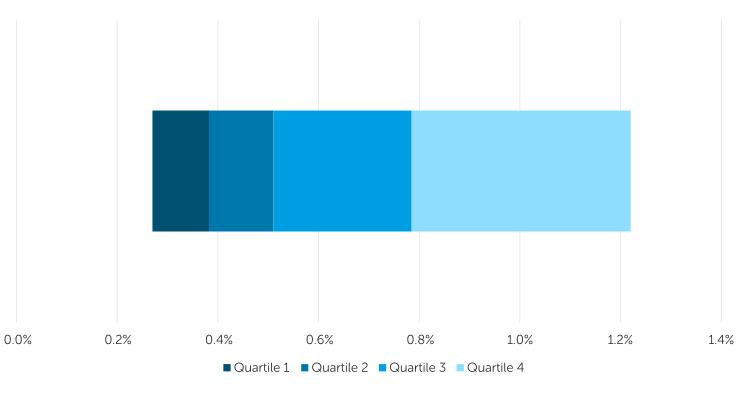
Source: Investment managers, BW as at 30 September 2025
This chart shows there is a significant spread in fees across the market. Headline fees in isolation don’t indicate value for money, so we’ve looked to understand what this difference could be paying for – whether in terms of better performance, risk management or service level.
What are you paying for?
Drawing conclusions in hindsight is easy, and some of our initial hypotheses seem obvious from the backward-looking data. However, you need to factor in what was known at the time and, therefore, how managers behaved during difficult periods. How did they make decisions and, importantly, did they keep their investors informed?
Looking back over the five-year period, one of the best investment decisions would have been to invest in low-cost passive equities. In fact, many DFMs, OCIO providers, and others will have had the ability to gain passive exposure within their multi-asset mandates, but did they? Over this period, we have seen managers react differently, with some going ‘risk on’ and others remaining cautious in light of uncertainty.
Equally important is sticking to what was promised. If you are paying your manager for an actively managed mandate, you would expect them to deliver that. Again, a full understanding is required to assess value.
Higher fees don’t necessarily lead to better returns
Our findings show that more expensive managers have failed to consistently outperform. In fact, when evaluating the past five years of performance data, the opposite is true: lower-cost managers have delivered higher returns on average.
The following chart plots returns against fees and shows the inverse relationship between fees and absolute performance.
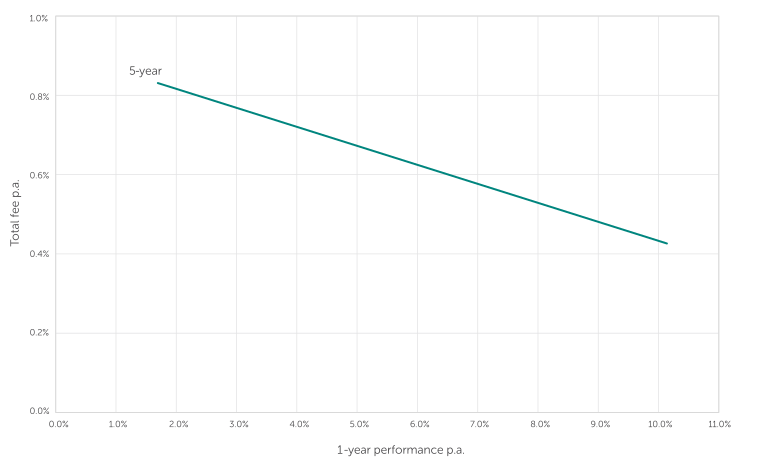
Source: Investment managers, BW
Five-year performance data to 30 September 2025.
Fees should not be interpreted as a proxy for value. Just because you are paying more for something does not mean it will lead to superior returns. On the surface, it seems like a no-brainer: lower fees, higher returns. Sign me up! But unpacking the data shows other factors need to be considered.
Over the past five years, we noted two themes in the data. The better-performing multi-asset managers had:
- higher exposure to equities; and
- within equity allocations, lower use of active management.
Naturally, we would expect these characteristics to come at a lower cost, so this conclusion is not surprising in an environment in which equity markets have risen significantly.
But these are multi-asset managers, investing in more than just equities. We cannot simply compare them with passive equity indices to assess performance. Investors should dig into the underlying drivers of return, including decisions around changes to asset allocations.
Time periods matter
Interestingly, if we dig further and consider each 12-month calendar year over the past five years, we see this pattern occurred in four out of the five years, but in 2022 the opposite was true.
2022 was a different market environment. As you can see, the higher-fee mandates outperformed the lower-fee mandates. This shows that active management can help within a multi-asset mandate, but manager selection and market environment are key.
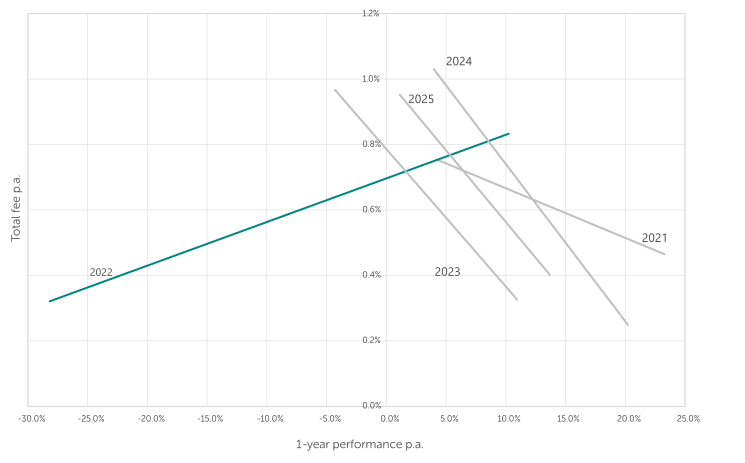
Source: Investment managers, BW
Five-year performance data to 30 September 2025.
If higher fees aren’t paying for higher performance, they may be compensating for something else investors care about: risk.
Higher fees don’t necessarily lead to better risk-adjusted returns
A common objective among active investment managers is to enhance returns and/or reduce risk. The analysis above showed returns were lower for the higher fee-paying managers over the five-year period, so what about risk?
When considering risk-adjusted returns, a clear pattern emerges: higher fees don't necessarily lead to better risk-adjusted returns. The chart below ranks managers by fees and by Sharpe ratio, a measure of risk-adjusted return, and maps the relationship between the two. This uses the same five-year period as above.
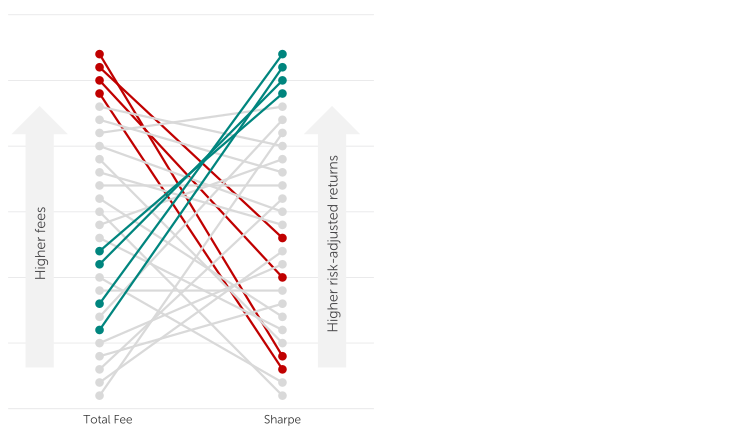
Source: Investment managers, BW
Five-year performance data to 30 September 2025.
As you can see, the lower cost offerings not only outperformed on an absolute basis, but also on a risk-adjusted basis over the five-year period.
Higher fees might lead to an improved service
A final consideration is whether higher-cost managers offer something more in terms of service.
We use ‘service level’ here as an umbrella term to capture a range of attributes you might look for in a manager. This includes a manager being easily contactable and responsive, providing timely support with queries – for example, if a key stakeholder needs data urgently – and attending meetings. But it could also refer to the ability to implement a more bespoke strategy, provide more regular strategic reviews, offer greater input into sustainability requirements, deliver tailored reporting, or provide broader governance support.
As a result of cost pressures, we have seen provider service levels vary in recent years. Our clients invest across a range of providers, and some have responded to fee pressure by scaling back some of the flexibility and tailoring they offer. By contrast, others would not want to compromise on service.
With more options increasingly available, investors need to factor service into any negotiations. Negotiations are not just about fees, nor are they only available to larger investors. We have helped a range of clients understand and benchmark their service levels against the market, and seek to get more from their manager.
Where does your investment manager fit into all of this?
Performance is not guaranteed, but fees are certain. Investors should ensure they know what they are paying and what this includes. Fee transparency is improving, but it is still difficult for investors to dig through several layers of management fees, performance fees, costs and charges to understand what is being taken from their assets and whether this offers value. There are many components that contribute to the total cost of a growth mandate, and even more ways providers package them.
Get in touch if you’d like to understand how your manager compares with the broader market, or if you’d like to know more.
Notes:
As part of our analysis, we looked at offerings from more than 25 investment managers covering a range of implementation options, including discretionary fund managers, OCIO providers, wealth managers and traditional asset managers. Data is as at 30 September 2025 and based on a £100m portfolio size unless otherwise stated. Past performance is not a reliable indicator of future performance.
Kit Moore, Senior Investment Analyst, co-authored this blog.

Get in touch
Our FM Evaluation Team supports selection and oversight of fiduciary management arrangements. Our Pension Executive & Management Services can help with establishing an Effective System of Governance and Own Risk Assessments.
Get in touch
Discover FM Evaluate
Our fiduciary management evaluation service has been designed to bring the independent and impartial oversight required to give trustees confidence in their FM arrangement.
Find out more