Our latest pensions accounting snapshot sets out some of the key issues affecting disclosures being prepared at 31 March 2026 under Accounting Standards FRS102 (UK non-listed), IAS19 (EU listed) and Accounting Standards ASC715 (US listed).
Please note that this briefing should not be taken as a recommendation for a particular course of action – please seek advice appropriate to your own circumstances.
Hot topics
Virgin Media vs NTL Trustees – Government response to historic benefit change uncertainty: Following the Virgin Media v NTL Trustees judgment (where it was ruled that benefit changes made without a valid ‘section 37’ certificate from the Scheme Actuary could be considered void), the UK Government introduced legislation in the Pension Scheme Act 2026 to give pension schemes the ability to retrospectively obtain written actuarial confirmation that historic benefit changes met the necessary standards. Guidance for actuaries providing confirmation has been published by the FRC, and TPR has produced guidance for trustees. This facility should reduce the risk of companies being required to recognise additional liabilities on the balance sheet.
Surplus extraction – great flexibility for defined benefit (DB) scheme sponsors: The Government’s 29 May 2025 response on “Options for DB schemes” confirmed its intention to introduce greater flexibility for surplus extraction from DB pension schemes – with the extraction threshold likely to be set at below buyout funding levels. This development could make a run-on strategy (continuing to operate the scheme rather than transferring liabilities to an insurer) more attractive for sponsors. However, the accounting implications of any strategy and agreements with trustees should be considered in advance.
Continuous Mortality Investigation (CMI) 2025 model – updates to life expectancy: CMI released its latest mortality projections model, CMI_2025, in March 2026, providing an updated view of post pandemic mortality trends. The model retains the pandemic related overlay first introduced in CMI_2024, with only routine calibration adjustments made to reflect the most recent mortality data. One of the most notable findings is a further rise in projected cohort life expectancies, driven by exceptionally low mortality in 2025. CMI_2025 results in a small increase in liabilities compared to the existing CMI_2024 model (between 0.3% and 0.5%, depending on the scheme maturity and the proportion of males/females).
Financial assumptions
Key trends:
- Corporate bond yields have shown a slight increase over the year to 31 March 2026, but the resulting reduction in liability values will be partially offset by an increase in levels of inflation for the majority of schemes.
- For schemes that have hedged all or most of their inflation rate risk, much of this decrease in liability value will also have been offset by falling asset values.
- Schemes that have retained more exposure to interest rate risk have likely seen a significant improvement in position, with generally strong growth asset performance over the year further supporting funding levels.
Discount rate
The accounting standards require the discount rate to be based on yields of high quality (usually AA-rated) corporate bonds of appropriate currency, considering the term of the relevant pension scheme’s liabilities. In our experience, audit firms prefer a single equivalent discount rate (SEDR) approach to be used when setting the discount rate.
Increasing corporate bond yields
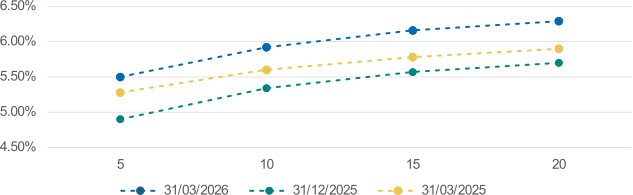
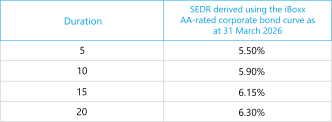
The chart below shows the movements since 31 March 2025 and 31 December 2025 in the single equivalent discount rates (SEDR) derived using the iBoxx AA-rated corporate bond curve based on sample cashflows for a range of durations. The rates at 31 March 2026 are also shown in the table.
Single equivalent discount rate by duration
Alternative yield curve constructions are available that can be used to increase the discount rate assumption.
Since 31 March 2025, the majority of schemes have likely seen a decrease in the value of their accounting liabilities, with corporate bond yields rising by between 0.3% p.a. and 0.4% p.a. at mid to long durations. At shorter terms, bond yields have changed less significantly, meaning schemes with shorter liability durations will see a smaller impact compared to those with longer durations.
Inflation
Retail Prices Index (RPI)
Market-implied future expectations vary depending on the term being considered. Consequently, inflation assumptions are normally set to be a single equivalent rate based on the full inflation curve.
The chart below shows single equivalent inflation rate assumptions based on the Bank of England inflation curve and sample cashflows for a range of durations, before any deduction for an inflation risk premium:
Single equivalent RPI inflation assumption by duration
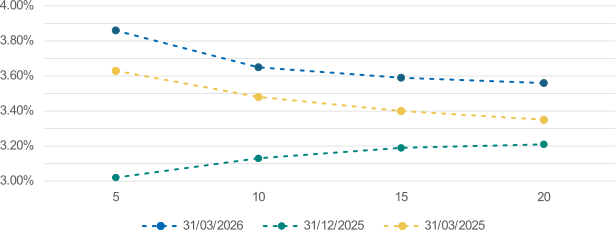
The chart shows a decline in long-term inflation expectations since 31 March 2025 in the period to 31 December 2025, with a more pronounced drop at shorter terms. In isolation, this would lead to a decrease in inflation-linked pension scheme liabilities. However, there has since been an increase in inflation expectations in the period to 31 March 2026 to a level higher than at 31 March 2025. This increase is approximately equal at different terms.
Consumer Prices Index (CPI)
For schemes with benefits increasing with reference to the Consumer Prices Index (CPI), for the assumption for CPI inflation is generally set with reference to the assumption for RPI inflation given the limited market for CPI-linked investments.
In light of RPI reforms due in 2030 where RPI will be aligned with the CPIH index, as well as changes in the way that housing costs will be measured from February 2024 onwards, an appropriate CPI assumption at 30 December 2025 is likely to be based on the gap remaining at around 1% p.a. up to 2030, with only a small difference (of up to around 0.2% p.a.) after that date. Further information on the upcoming changes to RPI and CPIH can be found in our 31 December 2024 briefing.
Growth asset performance
The chart below shows the performance of equity markets in the UK, US, Europe and Japan over the year.
Equity market returns
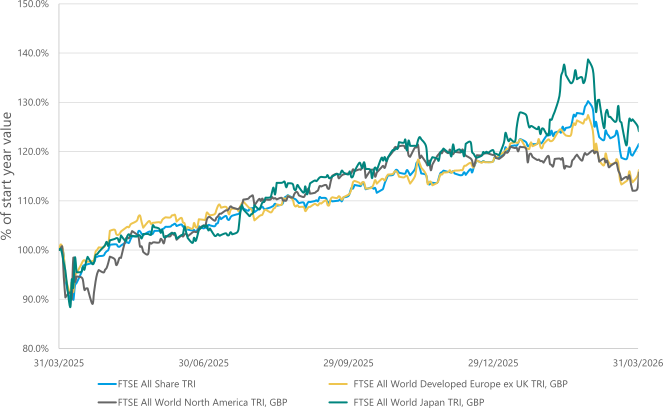
The chart demonstrates equity market returns gradually increased over the year to 31 March 2026. Markets rebounded well following a sharp decline in early April 2025, ending the 2025 calendar year in a strong positive position. Since the beginning of 2026, however, returns have been more uneven, reflecting a period of heightened volatility.

Stay up to date
Get the latest independent commentary and exclusive insights from a range of experts at the forefront of pensions, investment, insurance and risk – tailored to your preference.
Subscribe today