Skip to main content
Catalyst: DC pensions
DC PENSIONS TECHNICAL UPDATE | AUTUMN BUDGET SPECIAL
The Autumn Budget 2025
The Chancellor has outlined a tax-raising budget that aims to cut the cost of living, strengthen public services, and provide economic stability.
Following an unprecedented series of pre-budget leaks, briefings, and subsequent speculation, the Chancellor delivered her second Autumn Budget (the “Budget”) in the House of Commons. Although many headlines will focus on the accidental early publication of the Office for Budget Responsibility’s (OBR) fiscal outlook report, the most significant development for many occupational pension schemes’ sponsors and members is the introduction of a cap on the use of salary sacrifice arrangements for pension contributions.
At a glance
- Pension salary sacrifice capped – April 2029
- Minimum wages increased – April 2026
- ISA allowances reduced – April 2027
- PPF and FAS compensation indexed – January 2027
- DB scheme surplus unlocked – April 2027
- Inheritance tax and pensions – April 2027


- Income tax thresholds frozen
- Tax-free cash allowances and tax relief rules unchanged
- State Pension Triple Lock maintained
- Consider provision of support to members, offering clarity regarding the salary sacrifice cap and to remove any misunderstandings that pension contributions themselves are capped at £2,000.
- Review scheme rules and employer policies, particularly around DB surplus access and salary sacrifice limits. Conversations should be had between employers and payroll providers to prepare for the salary sacrifice cap, well in advance of implementation.
- Adjust compensation packages accordingly to account for the increases to minimum wages and subsequent implications following the freezes on personal tax thresholds.

Pension salary sacrifice capped – April 2029
Under a salary sacrifice arrangement, an employee agrees to give up part of their salary in exchange for a benefit offered by the employer, which is implemented by varying the employee’s contractual terms and conditions. This arrangement allows both the employer and their employee to save on National Insurance Contributions (NICs), as NICs are calculated based on the employee’s reduced salary.
From April 2029, the amount of employee salary sacrifice pension contributions (including bonus sacrifice contributions) exempt from NICs will be capped at £2,000 a year. The Treasury has confirmed that salary sacrifice contributions will still be exempt from Income Tax (subject to the usual pension allowances), and contributions above £2,000 can still be made through salary sacrifice arrangements (but these will be subject to NICs). It is important to note that these changes only relate to pension salary sacrifice and additional benefits offered via salary sacrifice do not fall within scope of the Budget changes. This may present an opportunity for employers to explore the use of, or expand on their use of, NIC saving via alternative salary sacrifice arrangements, such as Cycle-to-Work or Electric Vehicle (EV) Schemes.

This change can have a financial impact on both employees and employers where salary sacrifice is used. This example for a 5% contribution shows the potential impact:
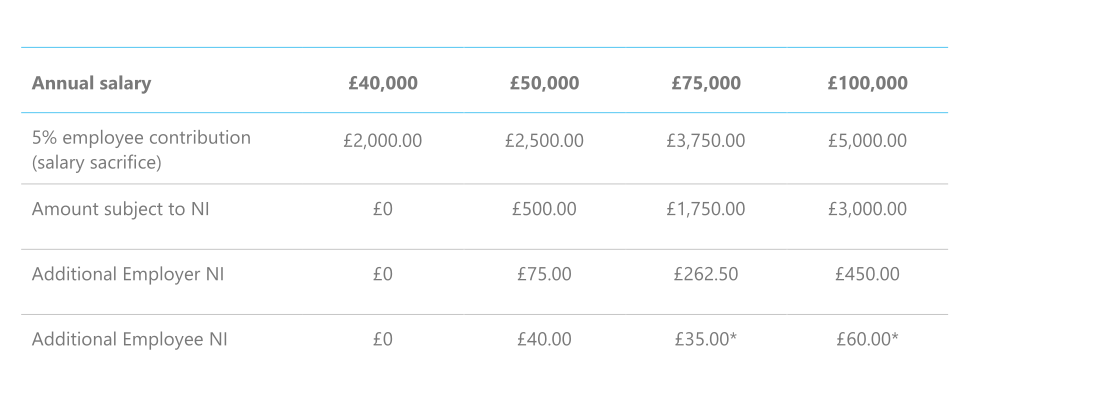
*Reduced salary is above £50,268, and therefore employee NI rates are taxed at 2% on the additional amount of employee contribution subject to NI, as opposed to 8% for the £50,000 annual salary example.
The Government has stated that these changes aim to “increase fairness, while protecting ordinary workers”, noting that the cost of relief through salary sacrifice disproportionately benefits higher earners. The Government estimate that 74% of basic rate taxpayers using salary sacrifice will be unaffected by the cap, and the OBR forecast that introducing it would raise £4.7 billion for the Government in 2029-30. Despite the cap being introduced, salary sacrifice remains a vital, tax-efficient method to improve members’ pension savings and retirement outcomes.
It is expected that employers will need to report the total amount sacrificed through existing payroll software. HMRC will consult with stakeholders and publish further guidance prior to April 2029.

Minimum wages increased – April 2026
The National Living Wage (NLW – for employees aged 21+) and the National Minimum Wage (NMW – for employees aged under 21) will be increased with effect from 1 April 2026, to provide additional support during the ongoing rise in cost of living.
The NLW will increase by 4.1% to £12.71 per hour, and the NMW will increase by 6% or 8.5% depending on the employee’s age. For 18-20 year olds the NMW will increase to £10.85 per hour and the rate for 16-17 year olds will increase to £8.00 per hour.
Following the increase in employer NICs, revealed at last year’s Autumn Budget, this announcement creates additional costs that employers will have to budget for and could have a material impact on subsequent business growth. It also creates additional risk for employers in ensuring that they comply with the new legislation, and that employees are not participating in salary sacrifice arrangements that take their earnings below the NMW/NLW. Employers may already have caps on salary sacrifice arrangements in place to prevent a scenario like this from occurring.
The automatic enrolment earnings trigger for 2026-27 has not yet been announced, but employers will also need to consider how this may impact on the number of eligible employees within their workforce.
ISA allowances reduced – April 2027
From April 2027, the overall annual ISA allowance will remain at £20,000 however, for those under age 65 the maximum Cash ISA limit will be reduced to £12,000.
With these changes, the Government intends to encourage investment over saving, through greater use of Stocks & Shares ISAs. The overarching aim of this policy being to help boost the economy and improve young peoples’ saving outcomes. This change will affect individuals who prefer to keep their savings in cash, restricting the amount that can be put into this tax efficient wrapper. However, this change may also encourage redirection of individual savings into pensions.
Pension Protection Fund (PPF) and Financial Assistance Scheme (FAS) compensation indexed – January 2027
The Chancellor also announced that Pension Protection Fund (PPF) and Financial Assistance Scheme (FAS) compensation, in respect of benefits accrued before April 1997, will increase in line with Consumer Prices Index (CPI) up to 2.5% p.a. (only where original scheme benefits included indexation under the scheme rules). This change will be welcomed by pensioners whose employers have become insolvent. However, there are concerns that this may raise expectations amongst members of solvent DB schemes for similar protections on pre-1997 benefits.
Whilst the aim of this policy is rooted in fairness and is intended to limit any further erosion in value of members benefits, it will not be backdated. Legislation will be amended via the current Pensions Schemes Bill, with relevant clauses expected to come into effect from January 2027.
Defined benefit scheme surplus unlocked – April 2027
In the May 2025 Pension Schemes Bill (PSB), the Government proposed measures to allow sponsoring employers access to DB scheme surplus. It was confirmed in the Budget, that well-funded DB schemes will be permitted to pay surplus funds directly to members who are over the normal minimum pension age (NMPA), provided scheme rules and trustees allow it. This potentially removes a barrier for some schemes in deciding whether to run-on.
It is expected that the PSB will be updated to include these provisions outlined in the Budget, and that they will then apply from April 2027.
Further Pension Inheritance Tax measures announced – April 2027
The Government has confirmed plans to bring most unused pension funds and death benefits within the scope of Inheritance Tax (IHT), for deaths occurring on or after 6 April 2027.
As part of the Budget, new measures will give Personal Representatives (PRs) additional powers:
- PRs will be able to instruct pension scheme administrators to withhold up to 50% of taxable benefits for up to 15 months and, in certain cases, use these funds to pay IHT;
- PRs will be discharged from liability for IHT on pensions discovered after they have received clearance from HMRC.
Since the withholding power only applies for 15 months, PRs need to finalise the IHT position within that window to benefit from this option. Any delay beyond that period could mean losing the ability to use withheld pension funds for IHT, so executors must ensure arrangements are completed within the 15-month timeframe.
These changes will be legislated in the Finance Bill 2025-26 and will take effect from April 2027. While the Budget confirms the policy, detailed guidance, and regulations (particularly around communications between PRs, pension scheme administrators, and beneficiaries), are still awaited. Administrators have requested at least 12 months’ notice to implement these changes.
Income tax thresholds frozen
The Government has extended the freeze on Income Tax and Secondary NIC thresholds from 2028 to April 2031. The thresholds for the Personal Allowance (£12,570), and the Basic, Higher, and Additional Rate tax bands, will therefore remain unchanged for the next six years.
While headline tax rates stay the same, the freeze creates “fiscal drag” or “stealth tax”, which has a significant impact on taxpayers. This refers to wages rising with inflation, leading to more individuals being drawn into paying Income Tax for the first time, and many moving into higher tax bands. The OBR predicts that by 2030, 780,000 more individuals will be paying Basic Rate Tax and 920,000 will move into the Higher Rate Tax band. Employers may face staff retention issues due to increased pressure from employees expecting pay rises to counteract this effect.
The financial impact is considerable for individuals and the Government. The OBR outlines that they predict this to raise £8 billion for the Government in 2029-2030 alone.

Tax-free cash allowances and tax relief rules unchanged
As in previous years, speculation ahead of the Budget suggested that the cap on tax-free retirement lump sums (Pension Commencement Lump Sum - PCLS), might be reduced. However, the Budget confirmed that the limit remains unchanged. The cap is set through the Lump Sum Allowance (LSA), which remains fixed at £268,275 (with higher limits for individuals holding certain protections).
Last year, fears of a cut to tax-free cash allowances led to some individuals taking lump sums earlier than planned. When the cap was left unchanged, some sought to reverse those withdrawals, however HMRC clarified that they cannot be reversed - a position reiterated ahead of this year’s Budget although some members will still have made financial decisions based on the rumours over the last few months. The Government reducing the LSA would likely have little fiscal benefit and would further reduce members’ confidence in pensions. Members require predictability regarding pension rules to avoid knee-jerk reactions that may harm their retirement outcomes.
Ahead of the Budget, there was also significant speculation that the Government might look to introduce a flat-rate tax relief for pensions or alternatively cut relief for high-earners. However, the Government has confirmed that marginal-rate tax relief on pension contributions will remain in place. Any shift away from marginal-rate tax relief would be highly complex and politically sensitive, as it would increase the cost of pension contributions for millions of people, whilst likely reducing take-home pay for higher earners in public sector DB schemes.
State Pension Triple Lock maintained
The Budget confirmed that the Triple Lock will remain in place until 2029 to help protect pensioner incomes. The Triple Lock guarantees an uplift in State Pension equal to the highest of; earnings growth, CPI inflation , or 2.5%. The Basic and New State Pension will therefore increase by 4.8% (reflecting earnings growth) from 6 April 2026.
From April 2027, the full new State Pension will exceed the frozen personal allowance of £12,570. The Government has said it will take steps to avoid pensioners with solely State Pension income having to pay tax via Simple Assessment.
From 6 April 2026, UK nationals living abroad will no longer be able to pay voluntary Class 2 NICs to build entitlement to the UK State Pension. Instead, they will typically need to pay the higher-cost Class 3 NICs, and only if they meet a new requirement of at least 10 years’ UK residency or NICs. The Government says the change will “end the ability for those living abroad to buy cheap access to a UK State Pension.”
Market impact
The Budget largely avoids contributing to inflationary pressures (unlike the 2024 budget) but will have negligible impact on growth expectations. As a result, the expectation that the Bank of England will cut rates in December, and the broader expected path of rate cuts, remains unchanged. Whilst this may benefit retirees in the short-term, this will likely lead to lower gilt yields and cash rates, which could negatively impact members 10-15 years from retirement.
Whilst there have been some movements in the FTSE and gilts market, the overall impact of the Budget on market movements is likely to be relatively small for investors. As yields remain broadly flat, the investment impact will have been muted for many DB and DC pension schemes, as well as other investors who hold UK government and corporate debt. DC schemes have also avoided a significantly weaker outlook for UK equity markets.

The Government announced three-year Stamp Duty breaks for companies new to the London Stock Exchange. Although this is positive news, Stamp Duty on UK shares remains an anomaly that disadvantages the UK versus other countries. The Budget lacked the growth-focused polices that markets are seeking, such as de-regulation, investment in Research & Development, and pro-worker pro-business taxation.
Other announcements
- Local Government Pension Scheme Reform – Stamp Duty Land Tax (SDLT) rules will be amended, so property transferred within Local Government Pension Schemes are subject to SDLT relief. This will be legislated for in the Finance Bill 2026-27.
- Catalysing pension investment into the venture capital market – the British Business Bank (BBB) intends to launch a consultation regarding the development of VentureLink, an initiative to help pension funds navigate the UK venture capital market.
Next steps
The Budget introduces a range of measures that will impact pensions, savings, and tax planning over the coming years. While the OBR expects a short-term hit to economic growth, fiscal headroom is forecast to double to £22bn in 2029-30, which should offer stability for potential long-term growth. The Chancellor deems the outlined changes necessary to meet fiscal rules that can withstand global turbulence, and provide finance for additional spending. This will require Government growth targets to be met, and spending plans to be controlled.
Further updates and detailed guidance will follow, with clarity likely to be provided in the Finance Bill (to be introduced December 2025). Whilst many of the changes may not take effect until April 2026/27 and beyond, trustees and employers should start preparing now by:
- Considering provision of support to members, offering clarity regarding the salary sacrifice cap and to remove any misunderstandings that pension contributions themselves are capped at £2,000.
- Reviewing scheme rules and employer policies, particularly around DB surplus access and salary sacrifice limits. Conversations should be had between employers and payroll providers to prepare for the salary sacrifice cap, well in advance of implementation.
- Adjusting compensation packages accordingly to account for the increases to NLW/NMW and subsequent implications following the freezes on personal tax thresholds.
Webinar: Autumn Budget implications for employers
Available on-demand
Watch our expert-led panel unpack the key outcomes and implications from the Chancellor's Autumn Budget.